Goodbye, Vibe Coding!
Hello, Agentic Engineering!
It has only been a year since the era of coding by intuition, yet Andrej Karpathy has pressed the upgrade button.
This time, it’s not about ‘vibe’ but about the harsh and precise nature of ‘engineering.’ Just yesterday, Karpathy presented his new concept—Agentic Engineering.

An Unexpected Hit
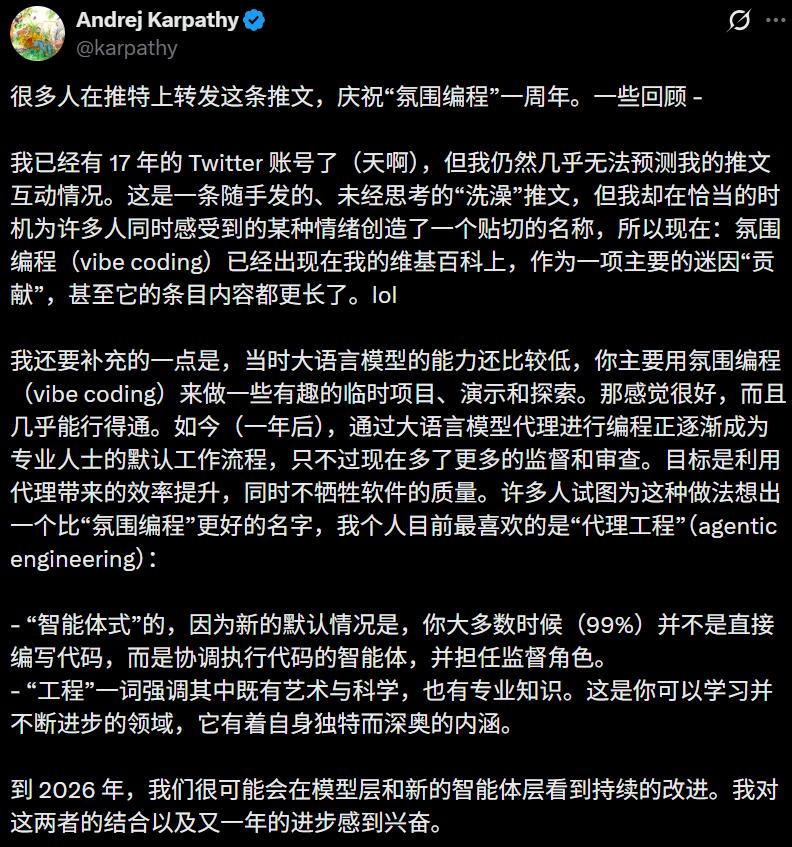
Looking back, Karpathy admits he was also surprised:
My Twitter account has been active for 17 years, but honestly, I still don’t fully grasp the rules of tweet interactions.
That tweet was essentially a ‘philosophical thought in the bath’; I posted it without much thought.
But somehow, it perfectly captured a shared sentiment at the right moment, giving it a name.
The outcome was somewhat absurd and funny—‘Vibe Coding’ became his main contribution to meme culture, even making it into Wikipedia, with the entry being longer than his own bio.
But jokes aside, Karpathy pointed out the core change:
A year ago, Vibe Coding involved using relatively weak LLMs for fun, one-off projects, demos, and small explorations. Today, programming with LLM Agents has become the ‘default setting’ for professionals, albeit with more supervision and scrutiny.
To distinguish this more rigorous, quality-focused approach from the previous ‘vibe flow,’ Karpathy introduced the concept of Agentic Engineering.
Agents are defined by the fact that you spend 99% of your time not directly writing code but directing agents to do the work, acting as a supervisor.
Engineering emphasizes that this involves art, science, and professional skills. It is a deep, improvable skill.
Looking ahead to 2026, the dual evolution of models and agents is just beginning.
Community Reactions
The introduction of this new concept quickly resonated within the developer community.
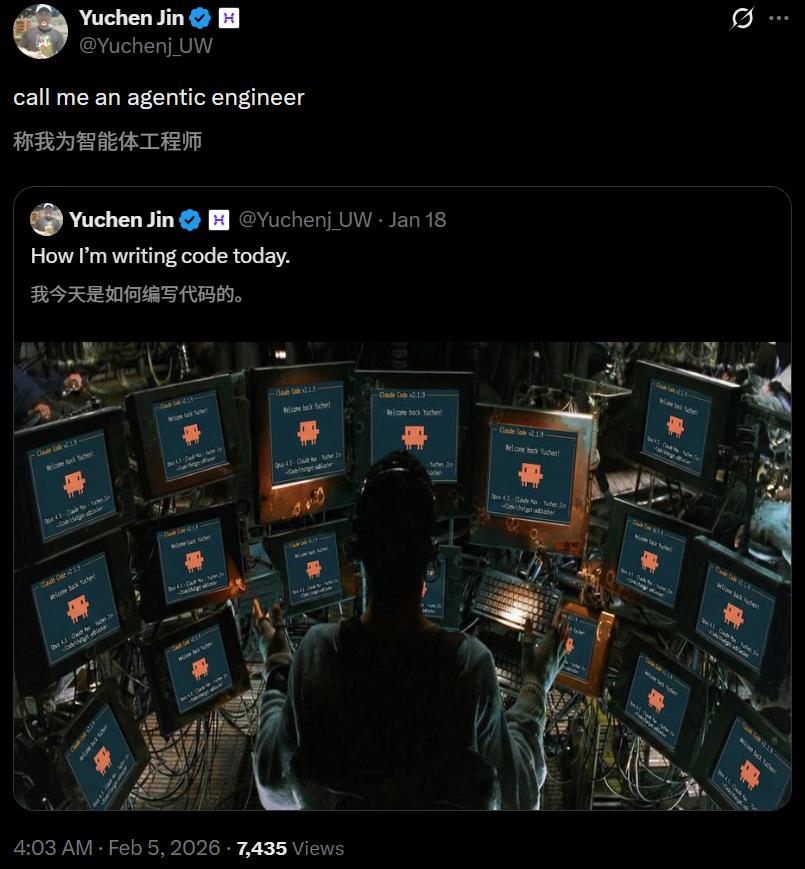
Yuchen Jin shared a screen matrix reminiscent of The Matrix, captioning it: “Call me an agentic engineer.”
Reefli humorously celebrated:
Everyone, take note, we just collectively leveled up from ‘vibe coders’ to ‘agentic engineers’!
David Ackerman pointed out that this is not just a name change but a sign of technological maturity:
Previously, ‘vibe coding’ was just for fun, but now the models are so powerful that the term simply means ‘efficiently utilizing AI.’

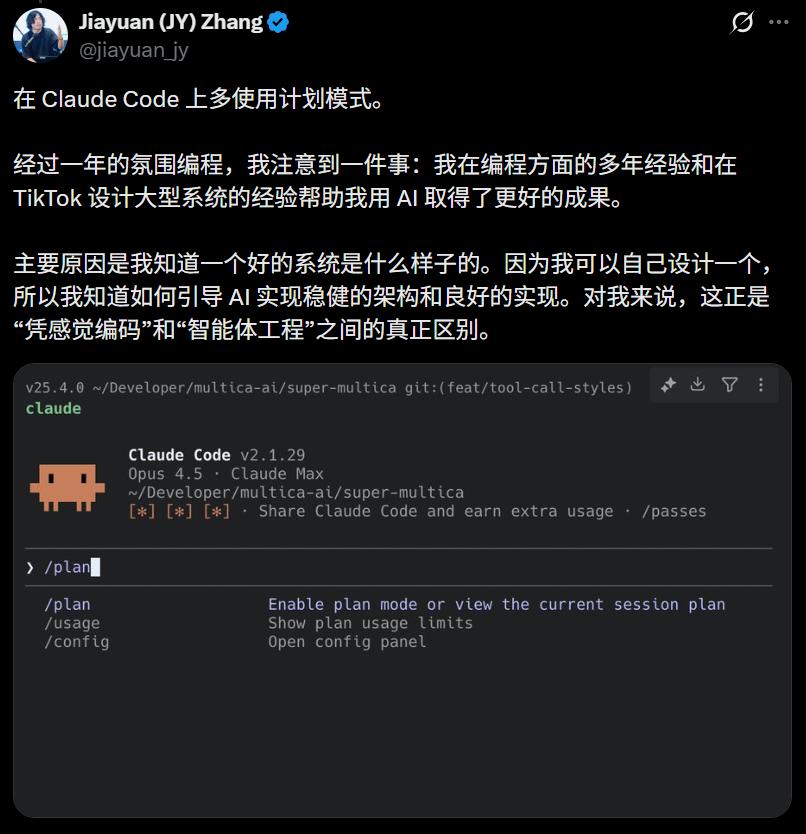
Jiayuan Zhang sharply noted the critical difference between ‘playing around’ and ‘professionalism’:
Experience in designing large-scale systems at major companies has actually enabled me to better manage AI. The core reason is that I know what a good system looks like. Because I have the ability to design, I can guide AI towards a stable architecture. This is the essential difference between vibe coding and agentic engineering.
The Real Key: Engineering
Karpathy’s observations hit the nail on the head: engineering is the keyword.
Many people were misled by the term ‘vibe,’ thinking that as long as the feeling was right, the code would run.
But reality is much harsher than internet memes.
Are You Coding or Gambling?
In today’s tech circle, the term ‘Vibe Coding’ has become overused.
Since Andre Karpathy introduced this concept, everyone seems to fantasize about a programming utopia where you just make wishes without questioning the process.
But the reality is brutal:
If you find the current AI programming experience filled with randomness and frustration, it’s likely because you’ve turned coding into a trip to the casino.
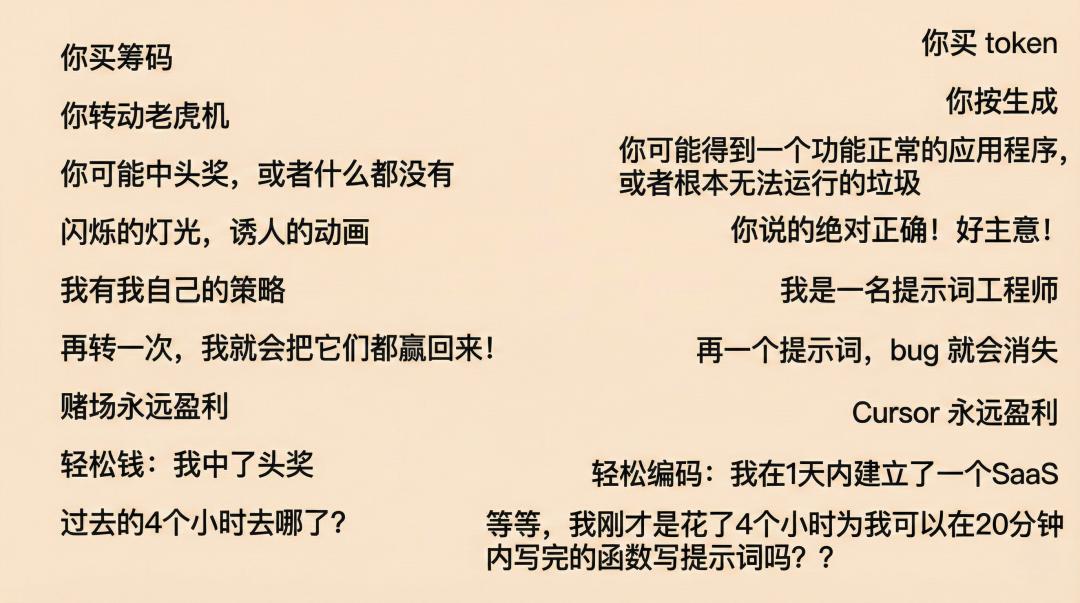
Let’s strip away the glamorous exterior of Vibe Coding and look at the actual workflow for most people:
Exchanging chips: Recharge Tokens
Pulling the lever: Input instructions, click generate
Waiting for results: Praying the code will run successfully
In the following seconds, your heart races, anticipating the appearance of a perfectly functioning full-stack SaaS application on the screen.
But most of the time, all you get is a bunch of flickering UI components, unresolvable logical dead ends, or a pile of meaningless garbage code.
At this point, the typical ‘gambler’s mentality’ kicks in.
You don’t check the code logic; instead, you tell yourself: ‘I have a strategy; I’m a Prompt Engineer.’
So you pull the lever again (Regenerate), hoping the next round will recover your losses.
The result is that you could have manually written the code in 15 minutes, but instead, you spent 4 hours playing a hopeless ‘lottery game’ with AI.
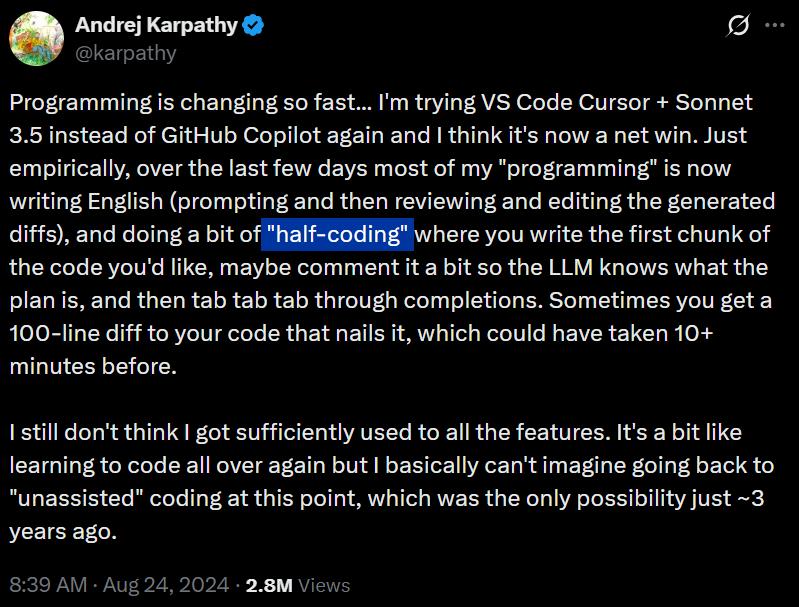
Even Karpathy’s mention of ‘Half Coding’ (watching AI write code) has taken a different turn for many.
They aren’t ‘supervising’ but instead staring blankly at the screen until an error appears, only then realizing what’s happening.
How to Become an Architect in the AI Era?
As Karpathy emphasizes the term ‘engineering,’ true experts engage in Vibe Engineering.
When you’re in the driver’s seat, you must scrutinize every line of code generated by AI as if you were watching a suspicious individual with a criminal record.
Your underlying message is always: ‘Hmm… I find your current approach a bit suspicious. Why are you writing it this way? Are you just making things up?’
This kind of technical intuition-based skepticism is key to mastering AI.

To achieve this level of control, we need two weapons:
1. Ramble like a madman
When an AI-generated UI has issues, don’t just type ‘fix this bug.’
Instead, try a seemingly crazy but highly effective technique: Brain Dumping.
You should open your microphone and argue with the AI as if it were a colleague sitting next to you, dumping all your contextual thoughts at once:
I see you changed this component, but the UI isn’t working as expected. I’m currently testing it, and look, when I click this button, it doesn’t respond.
I think the logic here shouldn’t rely on the state machine but should directly pull values from the context. Also, the part you just modified has overridden the original style, which won’t work…
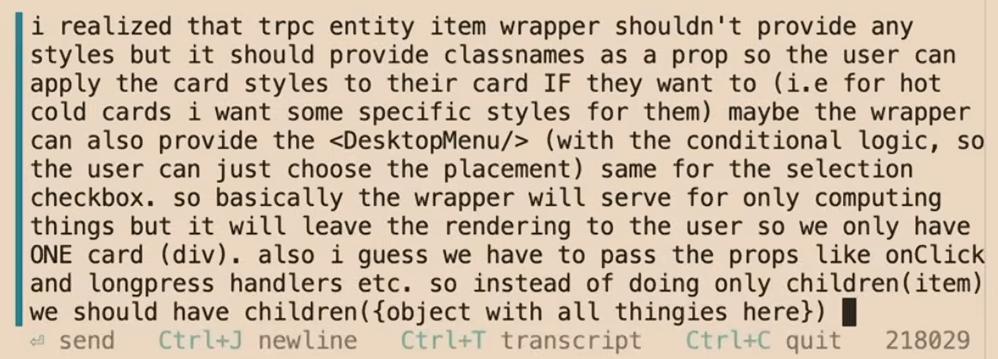
This several-minute-long voice input can convey rich context, including human intuition, logical reasoning, and causal relationships, to the AI.
The AI receives not just dry ‘instructions’ but vibrant ‘human intent.’
This is why those who only type ‘Make it work’ will never achieve good results, while those who can ‘talk a lot’ will achieve remarkable accuracy.
2. Speak the lingo like an architect
Besides communication style, Vibe Architecting is also a dividing line between novices and experts.
This is directly reflected in the prompts you use.
A: Build me a million-dollar app, don’t make mistakes, it must be perfect.
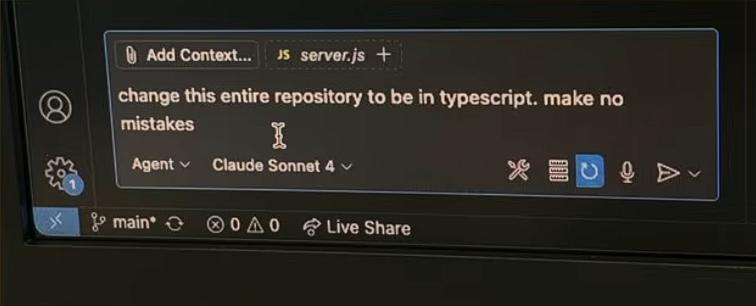
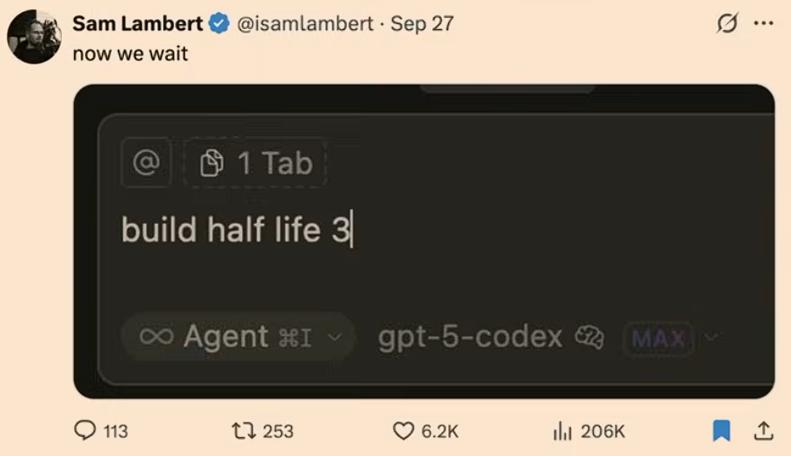
B: Use TRPC for front-end and back-end data transmission; the CRUD definitions should follow this specific abstract pattern; integrate NextAuth for authentication, don’t reinvent the wheel; abstract this logic into a custom hook while keeping the components pure.
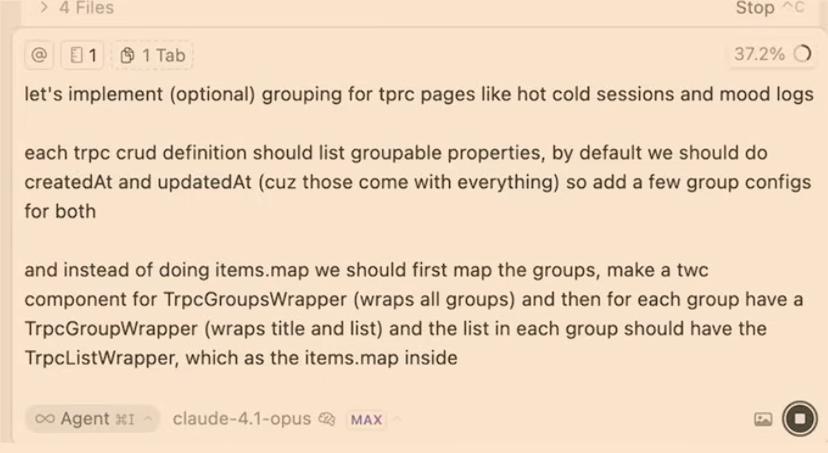
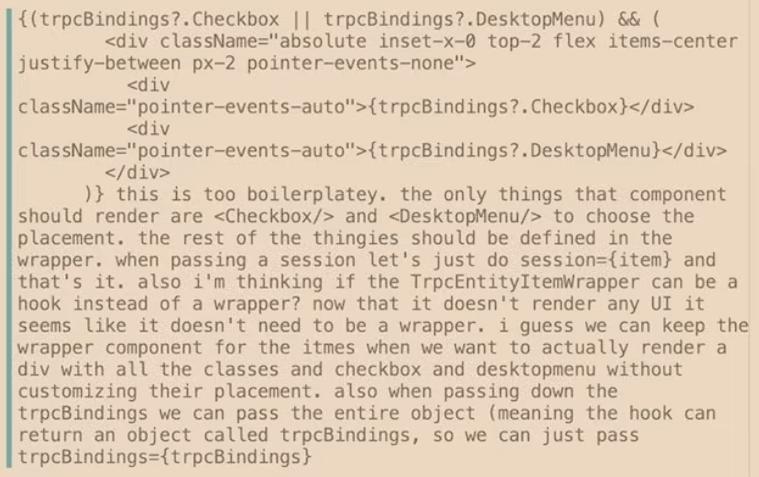
Do you see the difference?
The former is asking for a ‘result,’ while the latter is designing a ‘structure.’
You must visualize the code structure in your mind and instruct the AI ‘how to do it’ like a commander, rather than whining like a toddler about ‘what you want.’
The Programmer’s Fold
Finally, let’s critically examine this industry.
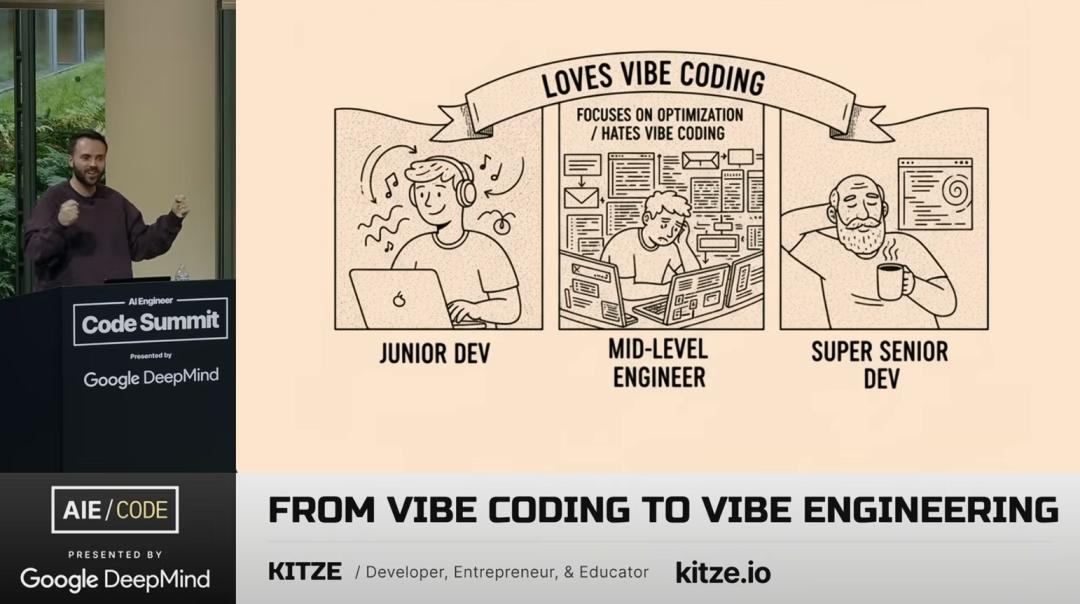
In the AI era, developers’ fates are being reshuffled, presenting a ‘spectral’ effect with peaks at both ends and a dip in the middle.
On one end are junior developers
They love Vibe Coding because it gives them the illusion of being omnipotent.
But unfortunately, due to a lack of judgment, they only generate a pile of unmaintainable ‘code mountains.’
On the other end are senior experts
They leverage Vibe Engineering for a tenfold efficiency boost.
Because they understand architecture, patterns, and can instantly identify that the AI-generated code ‘though not perfect, is good enough for the current functionality.’
This pragmatism allows them to rapidly advance projects, leaving their energy for the core architectural design.
To avoid being replaced, you must learn not just to ‘write’ code but to ‘design’ and ‘manage’ code.
And manage the AI intern that’s helping you write code.
Dual Evolution: The New Moore’s Law of 2026
Finally, Karpathy left a thought-provoking prediction in his tweet:
‘By 2026, we will witness the dual evolution of the Model Layer and the Agent Layer. I am excited about the multiplicative effect of both.’
Note, it’s multiplicative, not additive.
When the capabilities of models grow exponentially, coupled with the exponential maturity of Agent frameworks, we will enter an explosive period of ‘super individuals.’
What does this mean?
It means that the ‘One-Person Unicorn’ is no longer a myth.
As long as you master Agentic Engineering, you can be a development team, a product department, or even a startup all by yourself.
But the prerequisite is that you must start now, completing that painful ‘brain circuit upgrade.’
From ‘how to write this loop’ to ‘what role this loop plays in the entire system.’
From ‘fixing this error’ to ‘assessing whether this module is still needed in the architecture.’
This transformation will not wait for you.
When the hype of Vibe Coding fades, those who were swimming naked will find themselves left with a pile of non-functional code.
Meanwhile, those who have mastered Agentic Engineering will stand at the crest of the wave, weaving the future digital world with natural language.
Do you want to keep pulling levers in a casino, or take the driver’s seat to build your empire?
The choice is yours.
Comments
Discussion is powered by Giscus (GitHub Discussions). Add
repo,repoID,category, andcategoryIDunder[params.comments.giscus]inhugo.tomlusing the values from the Giscus setup tool.