Transformation of the Labor Market in the Age of AI: Will We Still Have Jobs?
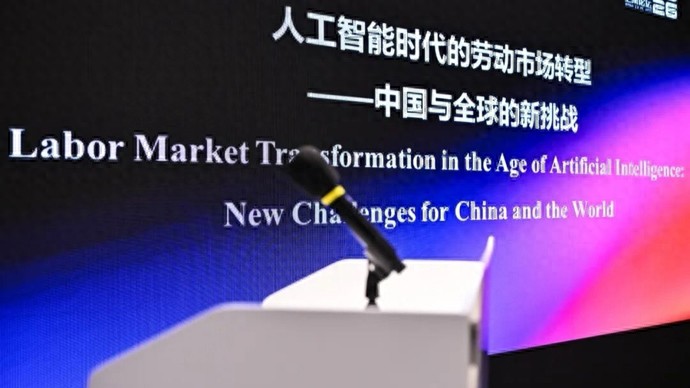
Recently, the Shanghai Forum hosted a sub-forum titled “Transformation of the Labor Market in the Age of Artificial Intelligence: New Challenges for China and the World,” organized by the China Economic Research Center at Fudan University. This sub-forum focused on the profound changes faced by the labor market against the backdrop of rapid AI development. Distinguished scholars from top universities and research institutions in China, the United States, South Korea, and Singapore discussed the impact of AI on employment structure, skill requirements, income distribution, and economic growth from multidisciplinary perspectives, utilizing big data and empirical industry analysis.
When AI becomes more capable than humans, where do we go from here? Harvard University economics professor Richard B. Freeman approached this from a “science fiction to reality” perspective, pointing out that many technologies once found in science fiction are accelerating into reality, particularly large language models and algorithmic advancements, which are profoundly changing the structure of the labor market. He emphasized that AI is gradually surpassing human capabilities in multiple fields, reshaping work methods and professional boundaries while imposing new requirements on individual capabilities. He cautioned that rather than simply worrying about technological replacement, we should focus on issues of income distribution and institutional arrangements—“who owns AI will reap more economic benefits.” In his view, AI could lead to efficiency leaps and reduce the gap between blue-collar workers and white-collar employees, but it might also exacerbate inequalities between AI owners and workers. Thus, the key to addressing these challenges lies in how society responds and adjusts through policies and institutions.
Zhu Feida, a tenured associate professor at Singapore Management University, explored how individual experience and knowledge can be transformed into “intelligent assets” in the context of AI deeply embedded in organizational operations. He noted that as AI can participate in or even replace some cognitive and creative tasks, the traditional human capital evaluation system, which centers on education and skills, is facing a redefinition. Internal workflows, decision-making paths, and tacit experiences within companies are being recorded, structured, and modularized through data and algorithms, creating reusable and scalable knowledge systems. He emphasized that future competitive advantages will increasingly stem from the collaborative capabilities of “human intelligence + artificial intelligence + organizational intelligence,” making the assetization of knowledge, governance, and value distribution critical topics in the AI era.
Zhang Dandan, vice dean of the National School of Development at Peking University and an economics professor, delivered a keynote speech on “How to Measure the Impact of AI on Employment.” From a methodological perspective, she systematically compared three measurement paths in current international cutting-edge research: the “AI Exposure Index” based on task decomposition, the “AI Adoption Index” based on corporate recruitment behavior, and the “AI Observation Exposure Index” based on real human-machine interaction data. These three indicators depict the impact of AI on employment from theoretical feasibility, actual corporate adoption, and individual usage behavior, complementing each other. She pointed out that these overlapping pieces of evidence converge on a consistent judgment: “theoretically pessimistic, but relatively mild in reality”—professions with potentially high exposure are generally concentrated in cognitive white-collar positions, but the deep implementation of AI at the corporate level is still in its early stages, with real impacts significantly lower than theoretical limits; the fate of professions with the same exposure fundamentally depends on whether their internal task structures are complementary or substitutive. She also warned that the breakthroughs in AI regarding “cognitive capability leaps” and “near-simultaneous global diffusion” have made the speed and breadth of this technological impact unprecedented, significantly compressing the adjustment window and raising higher demands for forward-looking monitoring, skill transformation support, and social buffering mechanisms.
Xie Danxia, a tenured associate professor at Tsinghua University’s Institute of Economics, constructed a general analytical framework for the “data-intelligent economy,” encompassing elements such as data, computing power, algorithms, and storage, to explore the growth mechanisms and employment impacts in the AI era. He pointed out that in extreme scenarios, production and innovation processes might primarily rely on data, computing power, and storage, significantly weakening the demand structure for traditional labor. Moreover, the impact of AI on employment has multiple effects: it may replace certain positions while also creating new opportunities by enhancing innovation efficiency, reducing knowledge burden costs, and promoting technological diffusion. Additionally, he proposed that AI could change work time allocation (such as reducing statutory working hours) and lifestyles through legislation, potentially affecting employment and demographic dynamics. Overall, institutional and policy adjustments will be key to responding to these changes.
Comments
Discussion is powered by Giscus (GitHub Discussions). Add
repo,repoID,category, andcategoryIDunder[params.comments.giscus]inhugo.tomlusing the values from the Giscus setup tool.